Cart
Your cart is empty
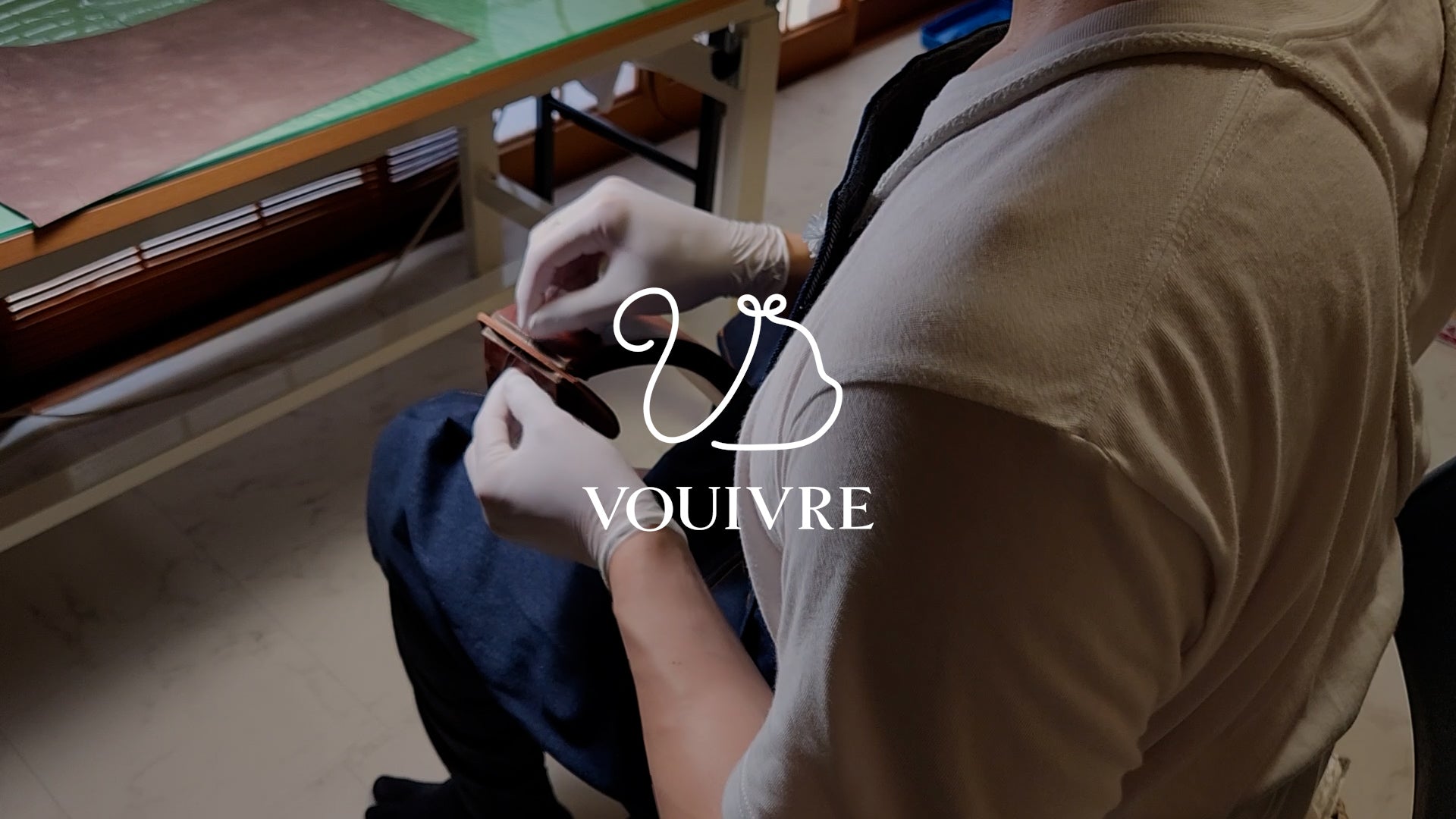
Please note that the method for crafting Pomme de Popotan and the artisan's one-of-a-kind stitching technique are confidential and not disclosed. The hand-stitching shown in the video uses the conventional method.
ⅠIt Began with Softened Leather
My leatherwork began with making momigawa — hand-softened goatskin.
I was drawn to shironameshi and chari-happo leathers, and wanted to make momigawa in the old manner. Studying whatever texts I could find, I started from the working of the hide itself.
It was there that I learned the history of leather.
ⅡThe First Wallet, Made Without Stitching
As a child, the one I went off to play with was my grandfather.
He took me into the mountains, where we gathered wild vegetables and fished together.
Then my grandfather passed away.
I still could not stitch leather.
Even so, I wanted him — a man who never carried a wallet — to go with plenty to his name. I wanted, more than anything, to make him one.
I had no knowledge of making things, but I worked out a wallet that could be built without stitching, put it together, and placed it in his coffin.
That leather wallet is my first original work.
Not being able to stitch it — that stayed with me. Had I been able to, I could have made him something better. I think so even now.
ⅢFrom Thread to Stitch
One day, I came across a work from the Edo period, and its stitching drew me in.
So I began by learning how thread was made in that era.
I gathered what I could from Japan's oldest association — how thread is spun, the tools for spinning, the knowledge of twisting — and sourced materials from around the world to learn to make thread myself.
Once I could make thread in every form, I wanted to see it become a seam.
And so my study of stitching began. By then, two years had passed.
There was still nothing I could make. Those around me told me skill did not matter — that design mattered more, that being able to produce things mattered more.
Even so, I believed then, and believe now, that nothing matters more than skill and history.
After that came wallets, bags, reupholstering sofas.
To widen what I was capable of, I took on anything.
Yet there was no work that truly held me.
ⅣMeeting the Gamaguchi
It was then that I met my partner.
When I mentioned that I worked with leather, she asked me to make her a wallet.
I did not want to give something ordinary.
My mother and grandmother had always used gamaguchi clasp purses; they were a familiar sight to me from childhood. So I decided to make one.
I crafted a nested gamaguchi purse in a leather of her favourite colour, and gave it to her.
It was far from the finish I would have wanted.
And yet, from that moment, the gamaguchi took hold of me completely.
So many gamaguchi in this world are awkward to use.
I came to think it was because their makers only made them, and never used them themselves.
I wanted to make a gamaguchi I myself would find easy to use. So I began from its history, and set out to make one that works just as well today.

As I began to make work of my own, I grew particular about my tools.
Reading the old texts of Japanese leathercraft, I learned about tools — and came to understand how much the awl and the leather knife matter.
A blade is useless unless it is sharpened. I felt I had to learn to prepare a tool before I could use one, so I walked from forge to forge in my region, looking for someone who would teach me to sharpen. Only one would.
Later I learned that those who make blades and those who use them sharpen differently.
I listened to temple carpenters and traditional craftsmen speak of sharpening, and from what they shared, I found my own way and refined it.
I grew particular about my whetstones, deepened my understanding of the blade, and raised the precision of my sharpening, step by step.
Every tool I use, I prepare with my own hands.
A day in my workshop begins not by touching leather, but by sharpening.
Leather knife, awl, needle.
Every blade I work with is reground to suit the task of that particular day.
Even the same task asks for a different angle and a different pressure from one day to the next — so the tool must be chosen to answer it.
From a tool treated with care, careful work is born. That is the belief I keep, and the way I keep making.

It all begins with seeing the material clearly.
First, I build a prototype in split leather.
Looking at what comes of it, I think: this kind of leather would suit it; this texture would bring out more of its character. And I search among leathers from around the world.
Then I make the piece, use it myself, and use only what convinces me.
Every hide has its own character, and every part its own nature.
This leather for this work.
And within a single hide, this part for this place.
I never choose a leather simply because it is renowned.
The right material in the right place — leathers, too, have what suits them and what does not.
That discernment is the foundation of something made to stay close to you.
I source thread from around the world, and twist each one from scratch by hand.
The under-twist alone runs to more than two thousand turns.
If the thread I wanted for hand-stitching did not exist, then I would simply have to make it myself.
Twisting from scratch makes the twist finer, so less of its surface meets the leather — it resists friction, and lasts far longer.
At first I made right-twist thread, and worked with it for my pieces.
I was right-handed. Yet once I began hand-stitching, I switched to my left.
The reason was simple: I came to see that the one who stitches must yield to the thread.
I make my own thread and my own needles. I even changed my dominant hand. I go this far because I am reaching for a way of stitching that is wholly my own.
Left-Twisted Thread

Right-Twisted Thread

Every stitch, every step — entirely by hand.
There is a finish that no machine can give.
Leather is not like cloth; the density of its fibres is never uniform.
Some parts are soft, others firm. Where to stitch, and where the tension will fall — I have studied the very act of hand-stitching, over and over.
I have tried hundreds of different ways of stitching.
A way to stitch a flat surface, a way to stitch in three dimensions, a way to draw out strength, a way to draw out beauty.
Even within hand-stitching, the right technique differs entirely with its purpose.
The method for stitching in three dimensions, above all, is one I devised myself.
The smooth, flowing curves of Pomme de Popotan could never have existed without it.
A stitching method of my own, and thread made with care. Where the two meet, a seam of rare beauty is born.
んだな、
びっとさねばまねだ。
That's what my grandpa would say, I think
※津軽弁で「そうだな、ちゃんとしないとだめだよ。」という意味
2017
Competed at the national championshipsas a physique athlete
2019
Injured his left hand in an accident
Lost his grandfatherMade his first work — a leather wallet
2021
Gave a nested gamaguchi purse as a giftBegan his study of the gamaguchi
2022
Completed “Pomme de Popotan”
2023
Granted patent, design and trademark rightsLaunched VOUIVRE
2024
Launched the brand Rhumore
2024
5th Mori no Miyako Craft Exhibition“Pomme de Popotan” selected
2024
Let’s Buy Aomori“Pomme de Popotan” certified as a new product
2025
Hirosaki City Hometown Tax donation gift“Pomme de Popotan” listed
2025
2025 Tohoku Regional Invention AwardAomori Invention Association President’s Award
2026
Hirosaki City Hometown Tax donation giftRhumore products listed
Something to stay close to you, for years to come.
That craftsmanship lives within both brands.
How did Pomme de Popotan come to be?
読み込み中...